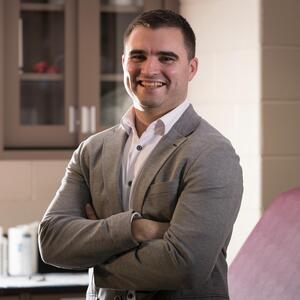

Evan Karagiozov
Evan Karagiozov
Adjunct Professor
Strength and Conditioning
Undergraduate Courses
KNPE 345 – Science and Methodology of Sport Training and Conditioning Programs
Adjunct Professor
Strength and Conditioning
KNPE 345 – Science and Methodology of Sport Training and Conditioning Programs
Adjunct Professor
Nutrition
Current Positions: Registered Dietitian at Kingston Health Sciences Centre
School of Kinesiology and Health since 2005, Queen’s University
School of Nursing since 2014, Queen’s University
HLTH 230 – Basic Human Nutrition
HLTH 230 – Basic Human Nutrition (ASO)
Professor
Cardiovascular Physiology
PhD (University of Waterloo)
MSc (University of Waterloo)
BSc (University of Waterloo)
Cross-Appointed to Department of Biomedical and Molecular Sciences
KNPE 225 – Advanced Human Physiology
KNPE 327 – Exercise Physiology Laboratory
KNPE 429 – Skeletal Muscle Oxygen Delivery: Demand Matching in Exercise
KHS 885 – Oxygen Transport in Exercise: Cardiovascular and Respiratory Responses to Increased Muscle Metabolic Demand
KHS 888 – Cardiovascular Function and Regulation in Exercise, Extreme Environments and Disease
Our tolerance for physical activity plays an important role in our quality of life, and depends in part on how well our muscle’s demand for oxygen is met. This requires that the cardiovascular system constantly adjusts blood flow to active muscles while maintaining arterial blood pressure. Accomplishing these goals requires integrated control of cardiac output with vasodilation and vasoconstriction of both exercising skeletal muscle and other vascular beds.
Basic Science Research in our laboratory is aimed at finding answers to the fundamental questions:
Biomedical Research in our laboratory is aimed at finding answers to the fundamental questions:
An additional Basic and Biomedical Research initiative that has begun in collaboration with colleagues in the Centre for Neuroscience Studies here at Queen’s University is aimed at understanding the mechanisms by which different types of exercise improve brain plasticity in older adults, and how exercise and cognitive training can best be combined to improve cognitive function, brain structure and cerebrovascular health.
Integrative, combined invasive and non-invasive research approach to understanding cardiovascular physiology in humans is critical in bringing relevance to knowledge gained from reductionist molecular, cellular and animal experimental approaches. In addition, advancing clinical application relies on understanding cardiovascular physiology in the intact human in both health and dysfunctional states. The Human Vascular Control Laboratory provides a training environment for those interested in innovative, integrative research approaches to understanding the integrative control of the cardiovascular system in humans and the role of exercise in brain health and function. The laboratory student compliment is capped at a maximum of 4 students, with any ratio of PhD to MSc students within that, in order to ensure that I have adequate meaningful contact with each student in their training as researchers. The lab will be accepting students for the Fall of 2017.
Natural Sciences and Engineering Research Council (NSERC) Discovery Grant 2011-2016
Natural Sciences and Engineering Research Council (NSERC) Research Tools and Instruments Grant 2011
Click here for Recent Publications
Click here for Recent Graduate Student Accomplishments
Associate Professor
Physical Activity Promotion for Persons with Disabilities, Knowledge Translation
PhD (McMaster University)
MSc (Queen’s University)
BPHE (Queen’s University)
HLTH 102 – Personal Health and Wellness
HLTH 332 – Foundations for Understanding Disability
Disability and Physical Activity (DIPA) Certificate Director
Researchers generate extensive new evidence about how physical activity participation can enhance physical, mental and social well-being. However, the application of these findings to the “real-world” remains a considerable challenge. At the same time, community, non-government and government organizations have guidelines, programs and services that seek to promote physical activity to benefit individuals and societies; yet, programs may not achieve their full potential if they are not evidence- and theory-based and collaboratively developed, and organizations may not know if their programs are effective if they are not rigorously evaluated. Herein lies the focus of my research program: I engage in innovative and applied research projects that close the gap between physical activity participation research and practice. The goal of my research program is to optimize physical activity participation for Canadians of all abilities. My research program builds a foundation that researchers and practitioners can use to design, implement, and evaluate “real-world”, physical activity participation-enhancing interventions that have maximal impact. The outcomes of my work improve the design and delivery of effective interventions, and thus, have the potential to improve the health of Canadians.
The following three principles are the cornerstones of my research program:
Opportunities exist for students who are interested in pursuing postgraduate training in knowledge translation for movement guidelines and/or physical activity promotion for persons with disabilities. Prospective students are encouraged to apply for funding from the Ontario Graduate Scholarship Program, the Canadian Institutes of Health Research, and other agencies that provide support for graduate students. Interested applicants should email Dr. Tomasone with a letter of interest along with a CV/resume and unofficial academic transcript.
Jennifer Tomasone on Google Scholar
Queen’s University Revved Up Lab
Associate Professor
Physical Cultures and Intersectional Justice
PhD (Simon Fraser University)
MSc (University of Toronto)
BHK (University of British Columbia)
KNPE 167 – Socio-Cultural Dimensions of Sport and Physical Activity
KNPE 366 – Race, Sport and Physical Activity
KNPE 475 – Sport and the Environment
My research broadly explores the relationship between physical cultures and intersectional justice. In other words, how are things like racism, sexism, ableism etc. also compounded by climate catastrophe? I question power relations and try to complicate our understanding of how, when, and where sport and/or physical cultures can be used to address issues of injustice. My doctoral research was published under the title, "Changing on the Fly: Hockey through the voices of South Asian Canadians" by Rutgers University Press (2020). Changing on the Fly won the Outstanding Book Award at the 2021 North American Society for the Sociology of Sport Conference. I have also executive produced a short documentary about bike waste titled, Revolutions, which won Best Canadian Short Documentary at the BC Environmental Film Festival. I am currently working on a SSHRC Insight Grant with Dr. Jennifer Wigglesworth (UNBC) about how historically marginalized groups work to create space for community and anti-colonialism through outdoor activities.
I am interested in supervising graduate students working in the areas of (new) media studies, intersectionality/intersectional justice, anti-racism, consumption culture, corporate social responsibility, (cultural) citizenship, fat activism, food studies, athlete activism, environmental sustainability/justice, outdoor culture (e.g., hiking, camping, mountaineering, climbing etc.), and public memory. Eligible students are expected to apply for SSHRC, CIHR, OGS and other available scholarship opportunities.
SSHRC Insight Grant (2022-2028). "Reclaiming the Outdoors: Structures of resistance to historical marginalization in outdoor culture." Co-Investigator, Dr. Jennifer Wigglesworth, University of Northern British Columbia.
Recent Publications
Szto, C. & Adams, M.L. (2023). "There's not a lot of glory in what I do": Coaches' views on Canadian ice hockey and figure skating development programs for adults. International Sport Coaching Journal, 11(2), 249-258.
Szto, C. & Wilson, B. (2023). Reduce, re-use, re-ride: Bike waste and moving towards a circular economy for sporting goods. International Review for the Sociology of Sport, 58(6), 911-931.
Szto, C., Pegoraro, A., Morris, E., et al. (2021). #ForTheGame: Social change and the struggle to professionalize women's ice hockey. Sociology of Sport Journal, 38(4), 325-334.
Szto, C. (2020). Changing on the Fly: Hockey through the voices of South Asian Canadians. New Brunswick, NJ: Rutgers University Press.
Bains, A. & Szto, C. (2020). Brown skin, white ice: South Asian specific hockey programming in Canada. South Asian Popular Culture. [online first]
Norman, M., Esmonde, K., & Szto, C. (2019). Public sociology of sport and digital media: A self-reflexive analysis of public engagement in the “hockey blogosphere.” Sociology of Sport Journal, 36(2), 135-143.
Szto, C. & Gruneau, R.(2018). The Hockey Night in Canada Punjabi Broadcast: A case study in ethnic sports media. In J. Anderson & J. Ellison (eds.), Hockey: Challenging Canada’s game. Ottawa-Gatineau: University of Ottawa Press.
MacDonald, C., Szto, C. & Edwards, J.(2017). The Game That No One Saw: Evaluating the cultural citizenship and legitimacy of women’s professional hockey through the Inaugural Women’s Winter Classic. In A. Milner & J.H. Braddock II (eds.), Women in Sports: Breaking Barriers, Facing Obstacles. Santa Barbara, CA: ABC-CLIO.
Hayhurst, L.M.C. & Szto, C.(2016). Corporatizing activism through sport-focused social justice?: Investigating Nike’s Corporate Responsibility initiatives in Sport for Development and Peace. Journal of Sport and Social Issues, 40(6), 522-544.
Gray, S. & Szto, C.(2016).A reflection of reality? The consumption and reproduction of obesity discourses by The Biggest Loser viewers through Facebook. The Journal of Social Media in Society, 5(3), 214-243.
Szto, C.(2016).#LOL at multiculturalism: Reactions to Hockey Night in Canada Punjabi from the Twitterverse. Sociology of Sport Journal, 33(3), 208-218.
Szto, C.(2015). Serving up change? Gender mainstreaming and the UNESCO-WTA partnership for global gender equality. Sport in Society, 18(8), 895-908.
Norman, M., Ventresca, M., Szto, C. & Darnell, S.(2015). ‘Driving to the Net’: Frames and politics in the New York Islanders’ stadium saga. Journal of Sport and Social Issues, 39(1), 19-39. doi: 10.1177/0193723514541282
Szto, C. & Gray, S.(2015). Forgive me Father for I have thinned: Surveilling the bio-citizen through Twitter. Qualitative Research in Sport, Exercise and Health, 7(3), 321-337. doi: 10.1080/2159676X.2014.938245
Szto, C.(2013). Saving lives with soccer and shoelaces: The hyperreality of Nike (RED).Sociology of Sport Journal, 30,
Donnelly, P., Atkinson, M., Boyle, S. & Szto, C. (2011).Sport for development and peace: A public sociology perspective. Third World Quarterly, 32(3), 589-601.
Associate Professor
Biomechanics and Motor Control, Neuromechanics
PhD (Simon Fraser University)
MSc (Queen’s University)
BSc (Queen’s University)
Cross-Appointed to the Department of Mechanical and Materials Engineering
KNPE 254 – Biomechanical Analysis of Human Movement
KNPE 353 – Experiments in Neuromechanical Kinesiology
KNPE 453 – Locomotor Neuromechanics
I am interested in the fundamental principles that shape how and why we move the way we do, as well as the application of these principles to improve mobility and overall health. To do so, I combine theoretical modelling, lab-based experiments, and data-driven approaches to study human locomotion and learning. In particular, I seek to understand the neuromechanical control of human walking and how it is adapted to changing tasks, environments, and bodies. Ultimately, the purpose of my work is to design novel rehabilitative strategies and wearable technologies to aid those with mobility impairments.
Current Research Themes:
Graduate Student Opportunities
I am currently accepting new graduate students at the Master’s and PhD level. Successful applicants will be encouraged to apply to the Ontario Graduate Scholarship Program and to the National Sciences and Engineering Research Council of Canada. If you are interested in learning more about graduate opportunities, please feel free to contact me.
Recent Publications
J.C. Selinger, J.D. Wong, S.N. Simha, and J.M. Donelan. How People Initiate Energy Optimization and Converge on Their Optimal Gaits. Journal of Experimental Biology, In Press, 2019.
C. S. Simpson, C. G. Welker, S.D. Uhlrich, R.W. Jackson, S.L. Delp, S.H. Collins, J.C. Selinger*, E. Hawkes*. Connecting the legs with a spring improves human running economy. Journal of Experimental Biology, In Press, 2019. *denotes equal contribution
S.N. Simha, J.C. Selinger, and J.M. Donelan. A Mechatronic System for Studying Energy Optimization. Dynamic Walking. IEEE Transactions on Neural Systems & Rehabilitation Engineering, 27: 1416-1425, 2019.
S.J. Abram, J.C. Selinger, and J.M. Donelan. Energy Optimization is a Major Objective in the Real-Time Control of Step Width in Human Walking. Journal of Biomechanics, 91: 85-91, 2019.
J.D. Wong, J.C. Selinger, and J.M. Donelan. Is natural variability in gait sufficient to initiate spontaneous energy optimization in human walking? Journal of Neurophysiology 121(5):1848-1855, 2019.
J.D. Wong, O’Connor, J.C. Selinger and J.M. Donelan. Contribution of blood oxygen and carbon dioxide sensing to the energetic optimization of human walking. Journal of Neurophysiology 118(2):1425-1433, 2017.
J.C. Selinger and J.M. Donelan. Myoelectric Control for Adaptable Biomechanical Energy Harvesting. IEEE Transactions on Neural Systems and Rehabilitation Engineering 24(3): 364-373, 2016.
J.C. Selinger, S.M. O’Connor, J.D. Wong, and J.M. Donelan. Humans Can Continuously Optimize Energetic Cost during Walking. Current Biology 25: 2452-2456, 2015.
W. Felt, J.C. Selinger, J.M. Donelan and C.D. Remy. ‘Body-in-the-Loop’: Optimizing Device Parameters Using Measures of Instantaneous Energetic Cost. PLoS ONE 10(8), 2015.
J.C. Selinger and J.M. Donelan. Estimating instantaneous energetic cost during non-steady state gait. Journal of Applied Physiology 117(11): 1406-1415, 2014.
Professor
Exercise Physiology
PhD (University of Montreal)
MSc (University of Montreal)
BEd (McGill University)
Cross-Appointed to School of Medicine, Department of Endocrinology and Metabolism, Faculty of Health Sciences
KNPE 255 – Physical Activity, Fitness and Health
KNPE 355 – Clinical Fitness Assessment Laboratory
KNPE 455 – Advanced Physical Activity and Health
KHS 886 – Clinical Exercise Physiology
Lifestyle and Cardiometabolic Research Unit
Our research work is focused on the characterization and management of obesity and related co-morbidities in adults. In recent years we have conducted a number of randomized controlled trials to determine the efficacy and effectiveness of lifestyle-based interventions designed to manage abdominal obesity and related health risk. Our objective is to continue this type of research for the foreseeable future.
Our intervention-based research is performed within 5000 square feet of space in the School of Kinesiology and Health Studies. This space includes the aerobic exercise equipment necessary to perform multiple intervention trials. Equipment for measurement of indirect calorimetry both during exercise and at rest is in place. Also included are 4 MRI- and CT-image analysis workstations. We also have routine access to MRI, MRS, CT and DEXA facilities at Kingston General Hospital. Our cardiometabolic-based research is performed within our Clinical laboratory space located within our laboratory and includes 2 beds, office space for our research nurses and two metabolic testing suites dedicated to performing our metabolic studies including hyperinsulinemic euglycemic clamp studies, glucose tolerance, glucose oxidation, resting metabolic rate measurement etc.
As the prevalence of obesity, diabetes and aging continue to increase worldwide, the importance of research designed to develop graduate students trained in these research areas is magnified. The research objectives of our laboratory are consistent with this observation and thus, graduate students in our lab are trained in fertile research areas that will develop the skills required within a broad spectrum of the research community.
Canadian Institute of Health Research (CIHR)
2020
Ross R. and Tremblay MS. Introduction to the Canadian 24-Hour Movement Guidelines for Adults aged 18–64 years and Adults aged 65 years or older: An Integration of Physical Activity, Sedentary Behaviour, and Sleep. Appl. Physiol. Nutr. Metab. 45(10) Suppl 2: v–xi, 2020.
Nelms M, Day AG, Sui X, Blair SN and Ross R. Examining the Influence of Waist Circumference in Cardiovascular Disease Risk Prediction Modeling. PLoS One 15(10):e0240214, 2020.
Ross, R, Chaput J-P, Giangregorio LM, Janssen I, Saunders TJ, Kho ME, Poitras VJ, Tomasone JR, El-Kotob R, McLaughlin EC, Duggan ME, Carrier J, Carson V, Chastin SF, Latimer-Cheung AE, Chulak-Bozzer T, Faulkner F, Flood SM, Gazendam MK, Healy G, Katzmarzyk PT, Kennedy W, Lane KN, Lorbergs A, Maclaren K, Marr S, Powell KE, Rhodes RE, Ross-White A, Welsh F, Willumsen J, and Tremblay MS. Canadian 24-Hour Movement Guidelines for Adults aged 18–64 years and Adults aged 65 years or older: An Integration of Physical Activity, Sedentary Behaviour, and Sleep. Appl. Physiol. Nutr. Metab. Vol. 45(10): Suppl. 2: S57–S102, 2020.
Ross R, Neeland IJ, Matsuzawa Y, Yamashita S, Shai I, Seidell J, Magni P, Santos RD, Arsenault B, Cuevas A, Hu FB, Griffin B, Zambon A, Barter P, Fruchart J-C, Eckel R, Després J-P. The Case for Waist Circumference as a Vital Sign in Clinical Practice. A Joint Position of the International Atherosclerosis Society and International Chair on Cardiometabolic Risk Working Group on Visceral Obesity. Nature Reviews, Endocrinology 16,177–189, 2020.
Katzmarzyk PT, Ross R, Blair SN, and Després J-P. Should we Target Increased Physical Activity or Less Sedentary Behavior in the Battle Against Cardiovascular Disease Risk Development? Atherosclerosis 311:107-115, 2020.
Kho ME, Poitras VJ, Janssen I, Chaput J-P, Saunders TJ, Giangregorio LM, Tomasone JR, Ross-White A, and Ross R. Development and application of an outcome-centric approach for conducting overviews of reviews. Appl. Physiol. Nutr. Metab. Appl. Physiol. Nutr. Metab. Vol. 45(10): Suppl. 2: S151–S164, 2020.
Janssen I, Clarke AE, Carson V, Chaput J-P, Giangregorio L, Kho ME, Poitras VJ, Ross R, Ross-White A, Saunders TJ, and Chastin SF. A systematic review of compositional data analysis studies examining associations between sleep, sedentary behaviour, and physical activity with health outcomes in adults. Appl. Physiol. Nutr. Metab. Vol. 45(10): Suppl. 2: S248–S257, 2020.
Tomasone JR, Kauffeldt KD, Morgan TL, Magor KW, Latimer-Cheung AE, Faulkner G, Ross-White A, Poitras VJ, Kho ME, and Ross R.
Dissemination and implementation of national physical activity, sedentary behaviour, and/or sleep guidelines among community-dwelling adults aged 18 years and older: a systematic scoping review and suggestions for future reporting and research. Appl. Physiol. Nutr. Metab. Vol. 45(10): Suppl. 2: S258–S283, 2020.
Saunders TJ, McIsaac T, Douillette K, Gaulton N, Hunter S, Rhodes R, Prince SA, Carson V, Chaput J-P, Chastin S, Giangregorio L, Janssen I, Katzmarzyk, PT, Kho ME, Poitras VJ, Powell KE, Ross R, Ross-White A, Tremblay MS, and Healy GN. Sedentary behaviour and health in adults: an overview of systematic reviews. Appl. Physiol. Nutr. Metab. Vol. 45(10): Suppl. 2: S197–S217, 2020.
Chaput, J-P., Dutil, C., Featherstone, R., Ross, R., Giangregorio, L.M., Saunders, T.J., et al. 2020. Sleep duration and health in adults: an overview of systematic reviews. Appl. Physiol. Nutr. Metab. Vol. 45(10): Suppl. 2: S218–S231, 2020.
Chaput, J.-P., Dutil, C., Featherstone, R., Ross, R., Giangregorio, L.M., Saunders, T.J., et al. 2020. Sleep timing, sleep consistency, and health in adults: a systematic review. Appl. Physiol. Nutr. Metab. Vol. 45(10): Suppl. 2: S232–S247, 2020.
Foti K, Whitsel L, Young DR, Hivert M-F, Ross R, and Appel LJ. A critical, unrecognized step in evidence-based policy making: Assessing the feasibility of conducting a clinical trial with hard outcomes. A Policy Statement from the American Heart Association. Circulation: Cardiovascular Quality and Outcomes. 13: e006378. DOI: 10.1161/ciroutcomes.119.006378, 2020.
Soultana M, Cameron C, Chaput J-P, Chulak-Bozzer T, Clark P, Davenport M, Faulkner G, Fowles J, Levesque L, Porter P, Rhodes R, Ross R, Spence JC, Vanderloo L, and Johnston N. Development of the 2019 ParticipACTION Report Card on Physical Activity for Adults in Canada. Journal of Physical Activity and Health, 17: 995-1002, 2020.
Phillips EW, Rao DP, Kaminsky LA, Tomkinson GR, Ross R, and Lang JJ. Criterion-referenced mCAFT cut-points to identify metabolically healthy cardiorespiratory fitness among adults aged 18–69 years: An analysis of the Canadian Health Measures Survey. Appl Physiol Nutr Metab doi: 10.1139/apnm-2019-0874, 2020.
Ross R, Soni S and Houle SA. Negative energy balance induced by exercise or diet: effects on visceral adipose tissue and liver fat. Nutrients 12(4), 891; https://doi.org/10.3390/nu12040891, 2020.
de Lannoy L, and Ross R. Non-exercise Equations for Determining Change in Cardiorespiratory Fitness. Med Sci Sports Exerc 52 (7):1525–1531, 2020.
Brennan AM, Day AG, Cowan T, Clarke GJ, Lamarche B, and Ross R. Individual response to standardized exercise: total and abdominal adipose tissue. Med Sci Sport Exerc 52 (2): 490–497, 2020.
Peterman JE, Arena R, Myers J, Marzolini S, Ross R, Stensvold D, Wisløff U, Lavie CJ, and Kaminsky LA. Development of Global Reference Standards for Directly Measured Cardiorespiratory Fitness: A report from the Fitness Registry and Importance of Exercise National Database (FRIEND). Mayo Clin Proc 95(2): 255-264, 2020.
2019
Ross R. Knowing That Cardiorespiratory Fitness Should Be a Vital Sign is Not Enough. Invited Commentary. Mayo Clin Proc 94(8):1395-1397, 2019.
Bonafiglia JT, Brennan AM, Ross R, and Gurd BJ. Estimating variability in individual responsiveness to training: An appraisal of the SDIR approach for parallel-arm exercise randomized controlled trials. Physiological Reports 7(14) e14163, 2019.
Muntaner-Mas A, Martinez-Nicolas A, Lavie CL, Blair SN, Ross R, Arena R, Ortega FB. A New Venue for Objective and Remote Assessment of Cardiovascular Disease Risk: Fitness Apps and Their Potential Usefulness in Clinical Practice. Sports Medicine 49:587–600, 2019.
Ross R, Goodpaster BH, Koch LG, Sarzynski MA, Kohrt WM, Johannsen NM, Skinner JS, Castro A, Irving BA, Noland RC, Sparks LM, Spielmann G, Day AG, Pitsch W, Hopkins WG, and Bouchard C. Understanding human exercise response variability. British Journal of Sports Medicine 53(18):1141-1153, 2019.
Neeland IJ, Ross R, Després J-P, Matsuzawa Y, Yamashita S, Shai I, Seidell J, Magni P, Santos RD, Arsenault B, Cuevas A, Hu FB, Griffin B, Zambon A, Barter P, Fruchart J-C, Eckel R. Visceral and Ectopic Fat, Atherosclerosis, and Cardiometabolic Disease: What the Clinician Needs to Know. A Joint Position of the International Atherosclerosis Society and International Chair on Cardiometabolic Risk Working Group on Visceral Obesity. Lancet, Diabetes Endocrinol. 7(9):715-725, 2019.
Bonafiglia JT, Ross R, and Gurd BJ. The application of repeated testing and monoexponential regressions to classify individual cardiorespiratory fitness responses to exercise training. Eur J Applied Physiol, DOI: 10.1007/s00421-019-04078, 2018.
2018
Kaminsky L, Arena R, Ellingsen O, Harber M, Myers J, Ozemek C and Ross R. Physical Fitness and CVD – the past, present and future. Progress in Cardiovascular Diseases. doi.org/10.1016/j.pcad, 2018.
Brennan AM, Tchernof A, Gerszten RE, Cowan TE, and Ross R. Depot-specific Adipose Tissue Metabolite Profiles and Corresponding Changes following Aerobic Exercise. Frontiers in Endocrinology. 9: 759, 2018.
Ozemek C, Laddu DR, Lavie CL, Claeys H, Kaminsky LA, Ross R, Wisloff U, Arena R, and Blair SN. An Update on the Role of Cardiorespiratory Fitness, Structured Exercise and Lifestyle Physical Activity in Preventing Cardiovascular Disease and Health Risk. Progress in Cardiovascular Diseases Vol 61, 5–6, 484-490, 2018.
de Lannoy L, Sui X, Blair S and Ross R. Comparison of Trained versus Untrained Cardiorespiratory Fitness on All-Cause Mortality Risk. European Journal of Preventive Cardiology. doi: 10.1177/2047487318809186, 2018.
Cowan TE, Brennan AM, Stotz P, Clarke J, and Ross R. Separate Effects of Exercise Amount and Intensity on Total and Abdominal Adipose Tissue in Abdominally Obese Adults. Obesity. doi:10.1002/oby.22304, 2018.
Hammond B, Stotz P, Brennan A, Lamarche B, Day A and Ross R. Individual variability in waist circumference and body weight in response to exercise. Med Sci Sport Exerc. 50(7):1480-1486, 2018.
Lang J, Phillips EW, Orpana HM, Tremblay MS, Ross R, Ortega F, Silva DAS and Tomkinson GR. Field-based measurement of cardiorespiratory fitness as a way to evaluate physical activity interventions in very high-, high-, middle-, and low-income countries. Bulletin of the World Health Organization. Article ID: BLT.213728, 2018.
Brennan A, Benson M, Morningstar J, Herzig M, Robbins J, Gerszten RE and Ross R. Plasma metabolite profiles in response to chronic exercise. Med Sci Sport Exerc 50(7):1480-1486, 2018.
de Lannoy L, Sui Z, Lavie CJ, Blair SN, and Ross R. Change in Submaximal Cardiorespiratory Fitness and All-Cause Mortality. Mayo Clin Proc 93(2):184-190, 2018.
Professor
Sociocultural Studies of Sport, Health and the Body
HLTH 235 – Food Systems
HLTH 334 – Health, Illness & Society
HLTH 430 – Critical Weight Studies
I have spent my career researching food insecurity and other issues related to poverty, class, food, and health. As a result, I am a critic of food charity and an advocate for a guaranteed livable basic income, an income floor that would provide all Canadians with adequate income to meet their basic needs, including food. My current research explores arts-based knowledge mobilization for effective solutions to food insecurity.
I am not accepting new graduate students at this time.
Links
Hungry Stories
Assistant Professor
Exercise Metabolism
PhD (University of Stirling UK)
MPhil (Liverpool John Moores University, UK)
BSc (Liverpool John Moores University, UK)
HLTH 331 – Advanced Human Nutrition
KNPE 449 – Advanced Protein Metabolism
The aim of my research program is to understand the cellular and molecular mechanisms underpinning the adaptive response of skeletal muscle to nutrition, exercise training, and immobilization. I specialize in the use of stable isotopic tracers to track skeletal muscle protein turnover combined with a variety of molecular biology techniques for measurement of enzyme activity, protein expression, and post-translational modification.
Prospective students are strongly encouraged to apply for scholarships and awards offered through the TriCouncil CGSM Master’s Award – National Sciences and Engineering Research Council of Canada (NSERC); other external agencies that provide funding to graduate students; and the Ontario Graduate Scholarship (OGS). Deadlines for these competitions generally fall in October — several months before the deadlines for our graduate programs. Only students who have already applied for funding from these external agencies will be eligible for the various internal fellowships and awards offered by Queen’s University to incoming students.
Professor
Psychology of Sport
PhD (Western University)
MA (Western University)
BA (Hons) (Western University)
KNPE 265 – Psychology of Sport and Exercise
KNPE 363 – Team Dynamics in Sport: Theory and Practice
My research interests lie in the general area of sport psychology with a particular focus on group dynamics principles. More specifically, I am interested in the psychosocial influences present in sport and physical activity settings, and how individuals’ can be influenced by, but can also influence the groups to which they belong. My current projects involve the investigation of group processes such as cohesion, cliques, social identity, and leadership on both individual and team level outcomes in child/youth and elite sport populations. Generally, the main focus is to develop a better understanding of certain psychosocial factors that can be used to inform interdisciplinary and policy relevant research aimed at enriching the sporting environment.
I am currently accepting applications from prospective graduate students. Successful applicants will be encouraged to apply to the Ontario Graduate Scholarship Program and to the Social Sciences and Humanities Research Council. If you are interested in learning more about graduate opportunities, please feel free to contact me.
Social Sciences and Humanities Research Council of Canada (SSHRC)
Mitacs-Accelerate Graduate Research Internship Program (GRIP)
Alberta Centre for Child, Family, and Community Research (ACCFCR)